.
What makes magic?
There is always a secret trick to magic-sometimes magic happens and it becomes legend-as is the case of the life of the furnishings for a room at Elsie de Wolfe's Villa Trianon.
Maybe it was more Alchemy than Magic.

an advertisement from the Frederick P Victoria & Son archives
featuring one of a pair of Italian Blackamoors groups from the Villa's Ballroom
It all began when Stephane Boudin of JANSEN made a suite of pieces for a Circus Ball at the Villa Trianon hosted by Elsie de Wolfe, Lady Mendl. On the night of July 2, 1938-with the Lady as ringmaster, the Circus Ball gave way to one of Elsie's many memorable rooms.

Oliver Messel painting of Elsie The Ringmaster

Elsie in center- between Sir George Clerk (at l) & her husband, Charles Mendl the night of the Ball
(images from the Campbell & Seebohm book Elsie de Wolfe A Decorative Life)
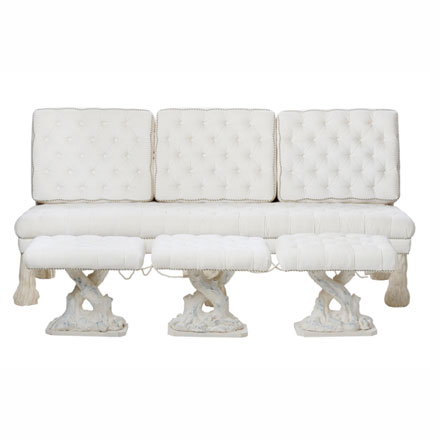
In order to accommodate the 700 guests for the Circus Ball an entire wing was added to the Villa Trianon. Boudin-the alchemist- created a dance pavilion with green and white stripe "disappearing" walls opening onto the Villa gardens, matching curtains inspired by the Regency- and that was just the backdrop for the special pieces in the room: banquettes, ottomans, circular seating, blackamoors, parasols, lanterns & trees.


scenes from the original Ballroom at Villa Trianon, above and below
(above images from Andre Ostier, the Elsie de Wolfe Foundation-and the Sparke book)

(The complexities of the relationship between decorator-Lady Mendl to decorator -JANSEN & Boudin, to hostess -Lady Mendl to patron with the funds- Paul-Louis Weiller are another part of the legend-told best in the definitive book ELSIE de WOLFE The Birth of Modern Interior Decoration by Penny Sparke.)
The next magician to possess the JANSEN CIRCUS pieces was the venerable house of Frederick P. Victoria & Son. Frederick Victoria-the alchemist- opened his legendary antique house in New York just a few years before the Circus Ball & today Frederick son's Tony-and Tony's son Freddie-carry on what began in 1933.
from their site:
Less well known was the fact that early on the company began to also offer full production capabilities to its top clients. These services included bespoke cabinetry, metalwork, finishing and upholstery to achieve the precise, and sometimes ambitious, results desired by its clients. After WWII, both the antique collections and the custom work of the company continued to earn a respected reputation. While clients included well respected families, artists and royalty, the company continued to focus on delivering the finest quality pieces and services, and for at least one client went so far as to keep the client’s actual name from its own workers.
A Conversation with Tony Victoria:
When did Frederic P. Victoria acquire the pieces from Elsie's legendary Villa Trianon pavilion? What were the circumstances of the acquisition?
TV:The house in Versailles was kept intact for years after she died by I believe a friend. Don’t remember his name. However in the early 80’s the Circus Room was offered for sale in one lot, if my memory serves, in Paris by Maitre Ader, I believe.
I heard about the sale, bought it and shipped all the elements back to my shop on 55th street.


images from Frederick P. Victoria & Son of archives of the Ballroom at their shop
showing the contents of the Ballroom after they were purchased at auction.
Everything minus the central planter,the planters on either side of the sofa & the “snail” stove behind the sofa, is from Elsie’s Villa Trianon room.
Did you purchase them with a particular client in mind or was it one of those –I just have to have those moments?
TV: I did not have a specific client in mind. I had heard Elsie’s name since my childhood. She would send these rather bizarre Christmas cards: a photo with her head resting like a sculpture on a small marble pedestal which itself was on usually a mantle piece with writing in white wishing my Father and Mother Merry Christmas. So when it came up, I was drawn to it. Besides, there were so many amusing elements that I felt I could find homes for all of them. And, I did.
Was it frenzied buying as I might imagine it would be today?
TV: I don’t remember too much about the auction itself. I don’t believe it was a “frenzied“ affair. Elsie de Wolfe’s name did not have the cachet in France then I don’t believe that is does, especially now, in America.
The room itself was quite expensive for the time, so after that lot I folded my own tent, as it were.

image from the Victoria archives
What was the condition of the pieces? What were the banquettes upholstered in? Was there a great deal of restoration to these and other pieces from the room?
TV: As I remember it all the upholstered pieces were upholstered in white canvas with green trim, a sort of signature combination for her. I did not recover anything, as for the most part everything was in presentable condition.
Freddie mentioned several things about the room in our conversation–the beautiful naturalistic lanterns and also mentioned of “Making that full-round tree for Michael Taylor . It has to have been one of my father's favorite projects.”
How did you do it?
Did you make the new one with the same materials-and what were they?
TV: As for making the tree for Michael, well one couldn’t say no to him, could one?
Plus he was buying a large chunk of the room, especially the trees which, while amusing, required a certain level of imagination, not to mention courage, to buy. As you know, he had both in depth.
As for favorite project, well I am not sure that I would use that term.
Certainly it was one of the craziest and most challenging of my career. I have always said that we, the firm, were ready to make anything for anyone. Little did I know that that would include a tree! The trunk was made in solid wood and somehow I was able to cajole my metal fabricator to make dozens of hand hammered leaves which he then affixed to metal stems. We then painted the leaves etc and then bent the stems and placed them we thought in more or less natural positions and groupings.

(Tony Victoria graciously answered these questions after a story I published on designer Michael Taylor here about the Garden Room he designed for Mrs. Stanley Dollar)
Frederick P Victoria & Son, Inc. their own blog here
Michael Taylor stories at little augury here
Elsie de Wolfe stories here
Frederick P Victoria & Son stories here
.