

Madame Eugenia Errazuriz in 1929
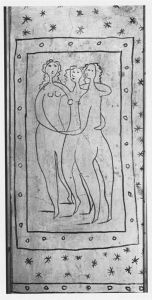
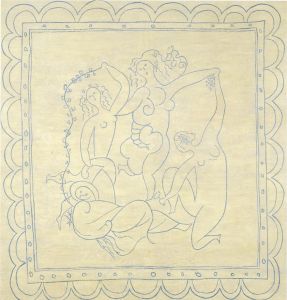
Picasso drew Madame 24 times. The woman Picasso met was approaching middle age.Eugenia had been married to a wealthy amateur landscape painter, lived in Paris and London, and back to Paris when her husband died. Her life was full, her admirers were numerous. It would be years before Picasso knew and fell for Eugenia- as mentor, muse, patron- There was no affair-but her influence was staggering. She is said to have refined the bohemian Picasso, introduced him to Diaghilev, prepared him for his audience with the Spanish King and polished him for his courtship with Olga Koklova-ballerina. Eugenia also provided the two with their honeymoon spot in Biarritz, where Picasso painted frescoes for a room in La Mimoseraie-her villa. Picasso said of the sketch of Eugenia below, "it's so handsome,I wouldn't even have let my father have it." According to the John Richardson HG article this sketch is identified as Eugenia-though it is debated to be her beautiful great niece Patricia. She does however look rather beautiful still in the first photograph dated 1929.
Picasso 1918


by Man Ray
the following drawings by Picasso
Decorations chez Madame Errazuritz
Biarritz, Summer/1918, Mural paintings 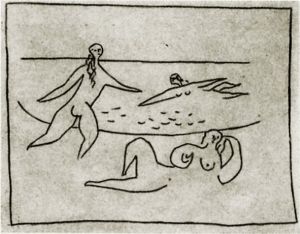
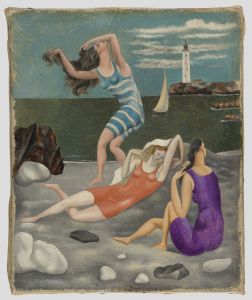
designer Chanel had a villa just next door-and Olga loved the
clinging bathing suits she made, Picasso painting them here.
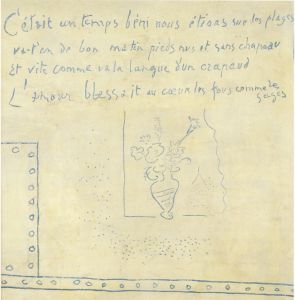
Much painted, admired, Madame Errazuriz's was painted by the likes of Sargent, Boldini, Blanche,Chartran, Helleu, Madrazo and Conder.. Sargent was one of the first to paint Eugenia when he met her as a young newley wed. A little in love with Eugenia, Sargent first met her in 1880 Venice and encountered her again in London, early 1900. An "A" List of artists were inspired by Eugenia- Augustus Johns, Walter Sickert (whom she collected), Braque, Diaghilev, Artur Rubinstein, Cocteau, Stravinsky, Blaise Cendrars and Le Corbusier. Proust referred to her specifically in his epic Remembrances of Things Past, "touched by art as if by heavenly grace, dwelling "in apartments filled with Cubist paintings, while a Cubist painter lived one for them, and they live only for him." Proust had been present when Eugenia unpacked Picasso's Cubist canvases and drawings after the war.
... as they saw her, before Picasso


1880
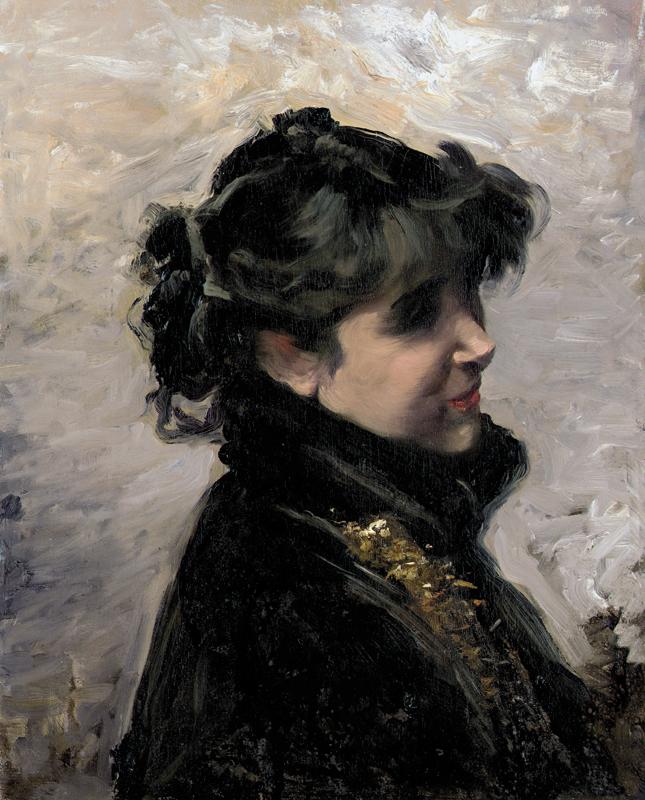


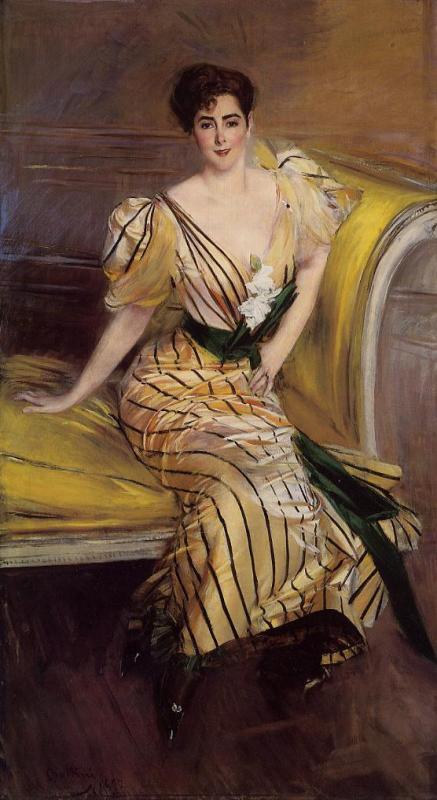
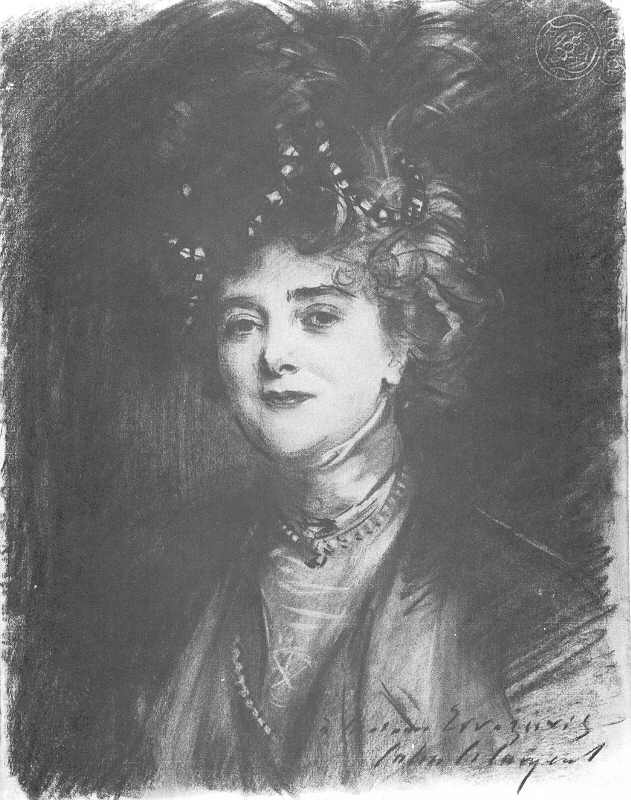
Sargent
1905
1905
Have you ever thought about the inspiration for bringing an inelegant rustic ladder into a soigne room originated? & when? Look no further than the elegant soigne Madame Eugenia Errazuriz. Cecil Beaton, in his Glass of Fashion (1954) wrote: "Eugenia's 'effect on the taste of the last fifty years has been so enormous that the whole aesthetic of modern interior decoration, and many of the concepts of simplicity... generally acknowledged today, can be laid at her remarkable doorstep.'
Perhaps some of Eugenia's design aesthetic preferences were a result of her education as a young girl by English nuns in her home country of Chile. Madame was a Franciscan lay nun and had her habit- a simple black shift-designed by Chanel. Jean Michel Frank wrote about her Paris apartment in Harper's Bazaar, accompanying the article, photographs by Kollar captured the foyer in the 1938 article.
"I love my house as it looks very clean and very poor" EE
"I love my house as it looks very clean and very poor" EE

the Hallway of Eugenia Errazuriz's Paris home
photographed by Kollar for Harper's Bazaar
Frank wrote "Her influence is indispensable." In his memoirs Stravinsky wrote, "Her friendship touched me deeply. She had a subtle understanding of modern art, which was unparalleled in anyone of her generation." She was comfortable discussing mysticism, astrology, religion and she, like Picasso, was terribly superstitious. Her patronage to the arts, & Her Artists, was in the spirit of alms giving- never financial aid.
Simply furnished with emerald green garden table and chairs, large baskets, and a gray coatrack decorated with a basket and an umbrella- laundry baskets and hampers stood along side it all. When Eugenia found the garden chairs the shop owner was horrified when she announced the folding garden chairs were for her Salon. Errazuriz used both dining and living spaces in her home as one large space-no room should be wasted. An old orchard ladder stands beside a modern deal cupboard Madame found in a street market. It must have been a shock to the hangers on of la Belle Epoque and the proponents of Elsie de Wolfe's design aesthetic. Of course- it appeared spontaneous-but to the contrary- it was a much studied. The slipcovers- in plain white or indigo-were ruthlessly tailored by the Balenciaga of upholsterers, chez Leitz. Never one to discriminate against the plainest mattress ticking-Madame would have dresses made from the material. Paul Morand remembers "she looked like a van Dongen in her blue straw hat, her dress of black and white mattress ticking, and a slash of carmine on her lips."


Jean Michel Frank studied Eugenia Errazuriz-absorbing all of the tenets of her modern approach to interiors-Frank would go on to realize many of her ideas in his brief but brilliant design career. Eugenia would never decorate for anyone else. Her choices were her own and belong to know one else. Her design was fearless-No one else was that brave.Certainly Errazuriz influenced these designers and their fast becoming- iconic-rooms. I especially see the Frederic Mechiche rooms as indicative of Errazuriz's. In the Mechiche rooms, there is a luxury, along with a spareness, that sets each element apart.

Rose Tarlow, 1990's
"Elegance means elimination." EE


Frederic Mechiche
(from the World of Interiors April 1997)

"A house that doesn't alter is a dead house.
One must change the furniture... rearrange it continually". EE
There was no excess.
Beaton inventories her salon-"an inkwell, blotter, a vase of fresh leaves, a flowering plant in an 18th century jardiniere, a magnificent commode," a Riesener bureau plat. She housed the objects she cherished in two large red lacquer cupboards. She used unlined blue and white stripe curtains with classic French furniture, House plants had to be aromatic- rose geranium, lemon verbena, lavender, jasmine-all in terra cotta pots- another often seen detail in design today. "Everything in Aunt Eugenia's house smelled so good." (EE's great niece Patricia). One 18th century bergere chair purchased by the adoring great niece- that Eugenia wanted desperately disappeared in just a month. Surprised to see the beloved chair gone, her niece inquired as to its whereabouts. Auntie replied, "I couldn't resist a change. I saw something I liked even better so I sold the chair to Emilio Terry."
However, nothing trumped the paintings that hung on whitewashed walls" Man in a Bowler Hat (1915), Seated Man (1915-1916) Her paintings remained fixed-her furniture was likely to move about- or Out

Beaton inventories her salon-"an inkwell, blotter, a vase of fresh leaves, a flowering plant in an 18th century jardiniere, a magnificent commode," a Riesener bureau plat. She housed the objects she cherished in two large red lacquer cupboards. She used unlined blue and white stripe curtains with classic French furniture, House plants had to be aromatic- rose geranium, lemon verbena, lavender, jasmine-all in terra cotta pots- another often seen detail in design today. "Everything in Aunt Eugenia's house smelled so good." (EE's great niece Patricia). One 18th century bergere chair purchased by the adoring great niece- that Eugenia wanted desperately disappeared in just a month. Surprised to see the beloved chair gone, her niece inquired as to its whereabouts. Auntie replied, "I couldn't resist a change. I saw something I liked even better so I sold the chair to Emilio Terry."
However, nothing trumped the paintings that hung on whitewashed walls" Man in a Bowler Hat (1915), Seated Man (1915-1916) Her paintings remained fixed-her furniture was likely to move about- or Out

image from Paris Originals
"A house that does not alter, is a dead house.
One must change the furniture,
or at least rearrange it continually.
This perpetual renewing is the beauty
and the strength of fashion.
In a house where nothing budges, the eye,
too long accustomed to the same scene
ends by seeing nothing."
Eugenia Errazuriz
(the same could be said of people)
Eugenia, who insisted that if the " Kitchen is not as well kept as the salon, if there are masses of old things lying about the bureau drawers, you cannot have a beautiful house-Throw out and keep throwing out." (Cleanliness is next to Godliness?) Living to the old age of 90, she became very frail after a car accident and declared, "I am tired of living, I wish to help God to take me out of this life." She refused food, letting go of her earthly possession- easy for Madame- she had been practicing all of her life.

further reading:
John Richardson's Sacred Monsters, Sacred Masters
Cecil Beaton's The Glass of Fashion
House and Garden April 1987, Tastemakers by John Richardson
NY Times.com The Queen of Clean
Jean-Michel Frank
.


