Popular Post
Showing posts with label Sculpture. Show all posts

Erwin Wurm: " WEAR ME OUT "

This summer, the Middlelheim Museum of Antwerp will be a playground for Austrian contemporary artist Erwin Wurm. A selection of 20 pieces, some on loan from international collections and others new, will be on display. The Wear me out exhibition is a true voyage of discovery through the open-air museum, where the visitor can wonder at Wurm's expressive art, while at the same time becoming a part of it. Erwin Wurm has invited fashion designer, Walter Van Beirendonck, to collaborate for the occasion.


Although Wurm claims that he became a sculptor almost by chance, he is completely at home in the genre. The forms and the materials he chooses always yield surprising results that both examine and push the boundaries of sculpture. A visitor to one of Wurm's exhibitions is far from a passive onlooker, but gets the chance to take part, to become a part of the artwork  himself, to join in with it. 


Wurm's work often makes use of everyday designs and situations from our own experience. His work is everywhere, in the streets, in everyday life: furniture, old clothes, houses, comics, household goods, amid cars, hand-knitted sweaters, and more...


Wear me out
Big Pumpkin, 2010 @Erwin Wurm @Xavier Hufkens Gallery, Brussels
Photo Jesse Willems

Big Psycho, 2010 @Erwin Wurm @Galerie Thaddaeus Ropac, Salzburg/Paris
Photo Jesse Willems

Big Psycho, 2010 @Erwin Wurm @Galerie Thaddaeus Ropac
Photo Jesse Willems

Big Gulp, 2009 @Erwin Wurm @Xavier Hufkens Gallery, Brussels
Photo Jesse Willems

Melting House @Erwin Wurm @Galerie Thaddaeus Ropac, Salzburg/Paris
Photo Jesse Willems

Big Sweater, 2010 @Erwin Wurm @Galerie Thaddaeus Ropac
Photo Jesse Willems

Fat House, 2003 @Erwin Wurm @Xavier Hufkens Gallery, Brussels/ Galerie Thaddaeus Ropac
Photo Jesse Willems

UFO, 2006 @Erwin Wurm @Xavier Hufkens Gallery, Brussels
Photo Jesse Willems

Misconceivable, 2010 @Erwin Wurm @Galerie Thaddaeus Ropac, Salzburg/Paris
Photo Jesse Willems

Knitwear Ceiling, 2011 @Erwin Wurm
Photo Jesse Willems
Wurm has created a new artwork in the Braem Pavilion using colorful knitting. The artist is wrapping the entire ceiling of the pavilion in a gigantic "sweater."

Performative Sculptures
@Erwin Wurm @Walter Van Beirendonck
Photo Jesse Willems


Performative sculptures, 2011 @Erwin Wurm and Walter Van Beirendonck
Braem Pavillion

Courtesy Erwin Wurm / the Middelheim Museum, Antwerp
Wear me out 
May 29 - September 25, 2011

Tony Cragg " Figure out / Figure in " at the Louvre

As a counterpoint to the presentation at the Louvre of the first retrospective in France devoted to the Austrian sculptor Franz Xaver Messerschmidt (1736-1783), the museum plays host to a group of sculptures by the British contemporary artist Tony Cragg, displayed in the Cour Marly and the Cour Puget. In addition, a new sculpture by the artist, produced especially for this exhibition, features under I.M. Pei's pyramid.
A graduate of the Royal College of Art in London, Tony Cragg has lived and worked in Wuppertal, Germany since 1977. Cragg has explored a wide variety of types of practice in sculpture and has made vast contributions to contemporary debates on sculpture. While his early works in the 1970s were mostly created using recovered objects, in his later work Cragg has used more traditional materials, such as wood, bronze, steel and marble, continually renewing his repertoire of forms, reaching towards an abstract appreciation of the human body.

A day at the Louvre......
Figure out / Figure in
Versus, 2010
Red wood

Ferryman, 2010
Bronze

Ferryman, 2010
and
Sharing, 2005

Accurate Figure, 2010
Bronze

Manipulation, 2010
Bronze

Red figure, 2010
Wood


Untitled, 2010
Steel

Runner, 2009
Bronze

Elbow, 2008
Wood


Photographs by Charles Duprat
Tony Cragg "Figure out / Figure in" is currently on view at the Louvre
From January 28 to April 25, 2011

Alexandre Mussard: " Les Petites Chaises "

Entitled " Les Petites Chaises," Little Chairs, is Alexandre Mussard's first exhibition at the Galerie Antonine Catzeflis in Paris. The 25-years-old French artist studied architecture and design at the Academie Charpentier, Esad Reims, and Ecole Camondo. It was during a course, by twisting a wire, that he gave shape to his first small chair.
" I have treasured this miniature sculpture. I immediately knew that it was going to become something essential for me. This little chair is like a character brought to light, fragile, playful and discrete....."
Mussard's show is dedicated to the chair in the form of miniature wire sculptures, displayed in various positions: chairs come alive, set in the middle of a circus tent - a wink to Calder's small circus - stacked on top of each other or suspended by balloons. Alongside the small artworks, including necklaces, are several larger chair sculptures.
Alexandre Mussard, a talent to watch who creates simple and poetic objects.

La boule rouge

La serre

L'acrobate

Le chapiteau
Le robinet

Le tiroir de Georges

Le nuage chaise
La corrida

La declaration


Bijou bronze - necklace


Le theatre des petites chaises


Le jongleur


Images, courtesy Galerie Antonine Catzeflis
23 rue St Roch, Paris 75001, France
Les Petites Chaises are currently on display at the gallery.

Haystack Mountain School

I’m back from two blissful weeks in Maine where I attended a fiber workshop at Haystack Mountain School of Crafts.

CAMPUS
Founded in 1950 at Haystack Mountain, the school moved to its current facility in 1961 on Deer Isle. The campus is a collection of cabins and studios, built into a hillside at the water’s edge. Edward Larrabee Barnes designed the compound, and in 1994, having stood the test of time, it received the Twenty Five Year Award by the American Institute of Architects.
From Barnes’s 2004 New York Times obit:
His Haystack Mountain School of Arts and Crafts…was not a building but a village of shingled cottages linked by a grid of wooden decks leading to a spectacular ocean view. Its diagonal forms were a much-noted departure from the cubical massing of the International Style that prevailed at the time. In 1994, the American Institute of Architects honored the project's influence with its 25-Year Award for older buildings, calling it "an early and profound example of the fruitful and liberating fusion of the vernacular building traditions with the rationality and discipline of Modern architecture."

The breathtaking view shifts gloriously with the fluctuating Maine weather. We drifted off to the sound of crashing waves at night, and woke to outgoing lobster boats in the morning.

Barnes’s Haystack architectural model and elevation of the campus are in the collection of MoMA.


NATURAL LANDSCAPE
The sub-tundra terrain of moss, lichen, pine, and glacial erratics provided a fascinating and enchanting landscape …


WORKSHOPS
The atmosphere is very conducive to working. Studios are open 24/7 and having prepared (and delicious) meals is very freeing.

Experimentation and exploration is encouraged and the teachers of the six workshops in session during my stay were all so inspirational. At night we got to see and hear about their work.

For example:

Kristen Morgin works in unfired clay.
Topolino, 2003
Monopoly, 2008

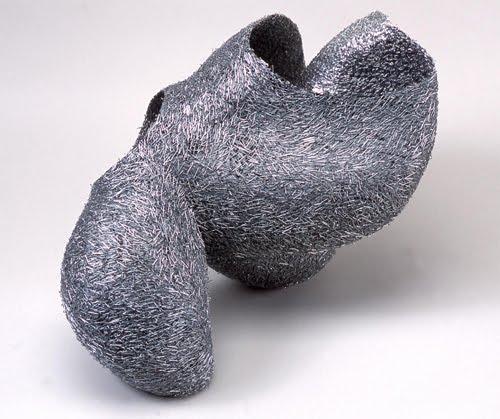
Jerry Bleem works with a wide range of found materials. The intriguing surface texture on these sculptures was created with staples.
June 10, 1983, 2000
Found printing plate, staples

Float, 2004
Fish scales, staples

Matthias Pliessnig works in steam-bent white oak.


Look through the Haystack workshop offerings to see other instructors.