
 It was just around now, early April, that I took a trip to Arizona, a few years back. I shot lots of great signs around Phoenix, but those will have to wait for another day. I’m afraid this post belongs to Mr. Lucky’s.
|
|---|
Showing posts with label color photography. Show all posts
Showing posts with label color photography. Show all posts
It's Mr. Lucky's Day
It was just around now, early April, that I took a trip to Arizona, a few years back. I shot lots of great signs around Phoenix, but those will have to wait for another day. I’m afraid this post belongs to Mr. Lucky’s.
Photochrom Landscapes
The landscapes, as promised. Are you thinking schmaltz? Treacle? Saccharine? I think they are dreamy.
 Praekestolen, Geiranger Fjord, Norway.
 Kongen og Dronningen, Bispen, Norway.

View towards Merok, Geiranger Fjord, Norway.
 The Seven Sisters, Nordland, Norway.
 Midnight sun, Bell Sound, Norway.
 Midnight sun in Advent Bay, Spitzbergen, Norway.
 Maderno, Lake Garda, Italy.
 Emerald Lake and Van Horn Range, British Columbia

Inspiration Point, Yellowstone, Wyoming.
 Grand Canyon, Arizona.
 Sunset on the Oklawaha, Florida.

Devil's Bridge, Aberystwyth, Wales. (I've been there!)
See previous post for details about Photochrom prints and read a good explanation of the process here.
See many more scenic Photocroms at the Library of Congress photostream on flickr.
 Praekestolen, Geiranger Fjord, Norway.
 Kongen og Dronningen, Bispen, Norway.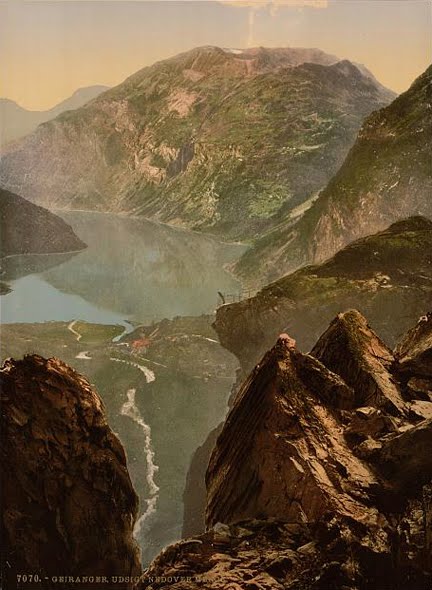
 The Seven Sisters, Nordland, Norway.
 Midnight sun, Bell Sound, Norway.
 Midnight sun in Advent Bay, Spitzbergen, Norway.
 Maderno, Lake Garda, Italy.
 Emerald Lake and Van Horn Range, British Columbia
 Grand Canyon, Arizona.
 Sunset on the Oklawaha, Florida.
See previous post for details about Photochrom prints and read a good explanation of the process here.
See many more scenic Photocroms at the Library of Congress photostream on flickr.
Almost Living Color
The Photochrom process was developed in Zürich, by Hans Jakob Schmid, in the 1880s. Used mostly for travel subjects, Photochroms took the place of hand-colored postcards, and were popular until the 1930s, when other color photographic technology became commercially viable.
The richly colored images were created by transferring a black and white photo onto a series of lithographic stones—anywhere from four to 14 -- that were then printed in color. In the U.S., the technology was licensed to The Detroit Publishing Company of Michigan, where thousands of views and millions of prints were produced. A very good technical explanation of the process can be found here.
The Library of Congress has more than 6,000 images, among which are the portraits and other peopled scenes here. Stay tuned for the mouthwatering landscapes ...

Portrait of Berta Lergetporer, Slovenia

Arrowmaker, an Ojibwa brave.

Pee Viggi and squaw.

National Vierlander costume, Hamburg, Germany.

A Chinese family.

Bedouin beggars and children, Tunis, Tunisia.

Bedouin Chief of Palmyra, Holy Land.

Bedouins and children outside tent, Holy Land.

Arab dancing girls, Algiers, Algeria.

Barbers near Seraskierrat, Constantinople, Turkey.

A Bedouin woman, Tunis, Tunisia.
The richly colored images were created by transferring a black and white photo onto a series of lithographic stones—anywhere from four to 14 -- that were then printed in color. In the U.S., the technology was licensed to The Detroit Publishing Company of Michigan, where thousands of views and millions of prints were produced. A very good technical explanation of the process can be found here.
The Library of Congress has more than 6,000 images, among which are the portraits and other peopled scenes here. Stay tuned for the mouthwatering landscapes ...


