Popular Post
Showing posts with label vintage postcards. Show all posts

Picturing Coney Island

Reginald Marsh, 1936
Tempera on panel, 59” x 35”
Via artchive

"I like to go to Coney Island because of the sea, the open air, and the crowds—crowds of people in all directions, in all positions, without clothing, moving—like the great compositions of Michelangelo and Rubens." --Reginald Marsh

The New York Times took yesterday’s heat as the opportunity to run its annual Coney Island photo on today’s front page. I like to think of it as just the latest installment in the long tradition of depicting the famed beach over the years.

Wegee, 1940

“… a great jammed clutter of human bodies,” was how photographer Weegee once described midsummer Coney Island.

You can see this image really large here. Read about "Weegee’s Day at the Beach" in Smithsonian and see more Coney Island images by the photographer.

Fortune has posted "To Heaven by Subway," an article about Coney Island, from its August 1938 issue. The above painting is by Robert Riggs, who illustrated the story.

From the same era as the Marsh and Riggs
paintings, is this 1932 picture by Mabel Dwight.

View of the beach from the air, Life, August 12, 1940.

Reginald Marsh, Coney Island Scene, c. 1932.
University of Virginia

Reginald Marsh, Coney Island Beach, etching, 1934.

It looks like Marsh was actually standing in the water when
he painted In the Surf, Coney Island, 1946.

In extreme heat, it was as crowded under the boardwalk as it was on the beach. Weegee, 1940.

George Tooker, 1947.
Christies

Lorenzo Homar, Muscle Beach – Coney Island, 1949
Princeton Library


Daily News, July 23, 2010.


Postcard, A Typical Crowd on a Hot Day at Coney Island, N.Y.

Royal Wedding Dress, Tonga


Had enough of Kate’s dress yet? This is the 1976 Tongan royal wedding of Capt. M. Tuita and Princess Pilolevu. (They say knock-off dresses were worn by Tongan brides and grooms for the next two seasons.)

Here is a link for more vintage postcards from Tonga.

Photochrom Landscapes

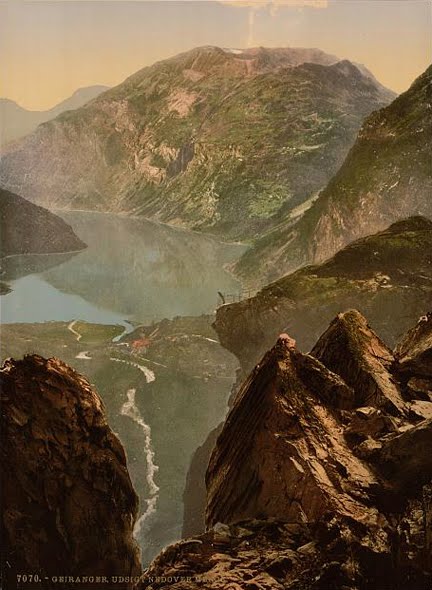
The landscapes, as promised. Are you thinking schmaltz? Treacle? Saccharine? I think they are dreamy.

Praekestolen, Geiranger Fjord, Norway.

Kongen og Dronningen, Bispen, Norway.

View towards Merok, Geiranger Fjord, Norway.


The Seven Sisters, Nordland, Norway.

Midnight sun, Bell Sound, Norway.

Midnight sun in Advent Bay, Spitzbergen, Norway.

Maderno, Lake Garda, Italy.

Emerald Lake and Van Horn Range, British Columbia

Inspiration Point, Yellowstone, Wyoming.


Grand Canyon, Arizona.

Sunset on the Oklawaha, Florida.

Devil's Bridge, Aberystwyth, Wales. (I've been there!)


See previous post for details about Photochrom prints and read a good explanation of the process here.

See many more scenic Photocroms at the Library of Congress photostream on flickr.

Almost Living Color

The Photochrom process was developed in Zürich, by Hans Jakob Schmid, in the 1880s. Used mostly for travel subjects, Photochroms took the place of hand-colored postcards, and were popular until the 1930s, when other color photographic technology became commercially viable.

The richly colored images were created by transferring a black and white photo onto a series of lithographic stones—anywhere from four to 14 -- that were then printed in color. In the U.S., the technology was licensed to The Detroit Publishing Company of Michigan, where thousands of views and millions of prints were produced. A very good technical explanation of the process can be found here.

The Library of Congress has more than 6,000 images, among which are the portraits and other peopled scenes here. Stay tuned for the mouthwatering landscapes ...

Portrait of Berta Lergetporer, Slovenia


Arrowmaker, an Ojibwa brave.


Pee Viggi and squaw.


National Vierlander costume, Hamburg, Germany.


A Chinese family.


Bedouin beggars and children, Tunis, Tunisia.


Bedouin Chief of Palmyra, Holy Land.


Bedouins and children outside tent, Holy Land.


Arab dancing girls, Algiers, Algeria.


Barbers near Seraskierrat, Constantinople, Turkey.


A Bedouin woman, Tunis, Tunisia.